




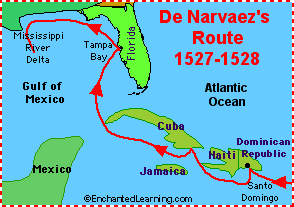
 Panfilo de Narvaez (1470?-1528) was a Spanish explorer and soldier. He helped conquer Cuba in 1511 and led a Spanish royal expedition to North America (leaving Spain in 1527). He was born in Valladolid, Spain and died on his expedition to Florida.
De Narvaez was granted the land of Florida by the Emperor Charles V in 1526. He led an expedition there with 250 to 300 men, including Cabeza de Vaca. After surviving a hurricane near Cuba, his expedition landed on the west coast of Florida (near Tampa Bay) in April, 1528, claiming the land for Spain.
A series of hurricanes and fights with Native Americans killed many of the crew, and the pilot of the ship sailed to Mexico without the men. The stranded men hastily made 5 makeshift rafts on which they sailed west, hoping to reach a Spanish settlement in Mexico. Three rafts sank, but the two surviving rafts (carrying 80 men) landed at Galveston Island (off what is now Texas). Narvaez did not survive.
After a very cold winter with very little food, only 15 men survived. In spring, the men traveled west by land, walking along the Colorado River. By 1533, there were only four survivors, including Estevanico, Carranza, Cabeza de Vaca, and Alonso Castillo Maldonado. The men were enslaved by some Indian tribes along the way, and helped by other tribes. They were the first non-natives to travel in this area of the southwestern North America. The four men finally reached the Spanish settlement of Culiacan in early 1536 (eight years after being stranded in Florida). Later that year they reached Mexico City, where they were welcomed by the Viceroy Antonio de Mendoza.