

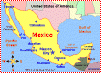


Captain Juan Bautista de Anza (1736-1788) was a Mexican-born trailblazer and explorer. He was the first person of European descent to establish an overland trail from Mexico to the northern Pacific coast of California (then called New Albion). He found a corridor through the desolate Sonoran Desert. His expeditions brought hundreds of settlers to California. He founded the cities of Los Angeles, San Francisco, and San Jose. De Anza was the commander of the presidio at Tubac.
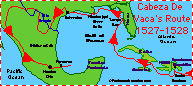
Alvar Nuñez Cabeza de Vaca [Cabeza de Vaca means “head of a cow”] (1490?-1557?) was a Spanish explorer who sailed to North America from Spain, leaving in 1527. He traveled from Florida to Texas on a raft, then walked from Texas to Mexico City. He also explored the Paraguay River in South America. De Vaca and his fellow travelers were the first Europeans to see the bison, or American buffalo.
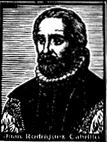
Juan Rodriguez Cabrillo (? -1543) was a Spanish or Portuguese explorer (his nationality is uncertain). Cabrillo was the first European explorer of the Californian coast. In 1542, he sailed from Acapulco to southern California, claiming California for King Charles I of Spain. Cabrillo named San Diego Bay and Santa Barbara. He died on San Miguel Island (in the Santa Barbara Channel) after a fight with Indians, from complications resulting from a broken leg.
Sebastian Meléndez Rodríguez Cermenho (also written Cermenon) was a Spanish navigator and explorer (Cermenho was Portuguese by birth). Cermenho was directed by Cortés to explore the California coastline in 1595. With a crew of 70 men on the Manila (Philippines) Galleon San Agustin in the service of Spain, Cermenho sailed from the Philippines to California. After running aground near Point Reyes (north of San Francisco), Cermenon named the nearby bay San Francisco (it is now called Drakes Bay). They built a smaller boat from the wreckage and sailed to Acapulco, Mexico, charting the coastline all the while.
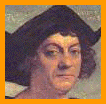
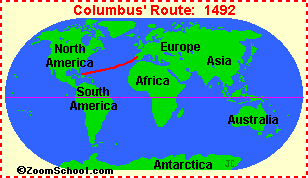 Christopher Columbus (1451-1506) was an Italian explorer who sailed across the Atlantic Ocean in 1492, hoping to find a route to India (in order to trade for spices). He made a total of four trips to the Caribbean and South America during the years 1492-1504, sailing for King Ferdinand II and Queen Isabella of Spain. On his first trip, Columbus led an expedition with three ships, the Niña, the Pinta, and the Santa Maria.

Francisco Fernández de Córdoba (? - 1524) was a Spanish explorer and slave trader who explored Mexico (1517) and Nicaragua (1524).
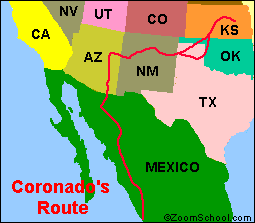 Francisco Vásquez de Coronado (1510-1554) was a Spanish ruler, explorer and conquistador. He was the first European to explore North America’s Southwest.
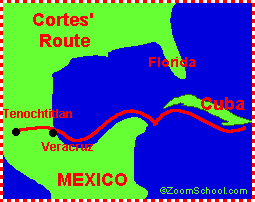
Hernán Cortés (also spelled Cortez), Marqués Del Valle De Oaxaca (1485-1547) was a Spanish adventurer and conquistador (he was also a failed law student) who overthrew the Aztec empire and claimed Mexico for Spain (1519-21).
Cortes sailed with 11 ships from Cuba to the Yucatan Peninsula to look for gold, silver, and other treasures. Hearing rumors of great riches, Cortés traveled inland and “discovered” Tenochtitlan, the capital of the Aztec empire. He then brutally killed the Aztec emperor Montezuma and conquered his Aztec Empire of Mexico, claiming all of Mexico for Spain in 1521. Treasures from the Aztecs were brought to Spain, and Cortés was a hero in his homeland. Cortés was appointed governor of the colony of New Spain, but eventually fell out of favor with the royals. He then returned to Spain where he died a few years later.
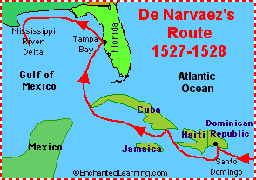
Panfilo de Narvaez (1470?-1528) was a Spanish explorer and soldier. He helped conquer Cuba in 1511 and led a Spanish royal expedition to North America (leaving Spain in 1527). He was born in Valladolid, Spain and died on his expedition to Florida.
De Narvaez was granted the land of Florida by the Emperor Charles V in 1526. He led an expedition there with 300 men, including Cabeza de Vaca. After surviving a hurricane near Cuba, his expedition landed on the west coast of Florida (near Tampa Bay) in April, 1528, claiming the land for Spain.
Fray Marcos de Niza (1495 - March 25, 1558 ) was a Franciscan priest who is said to have traveled to the fabled “Seven Golden Cities of Cibola” in what is now the western part of New Mexico.
De Niza was born in Savoy (now in France, but it was Italian then), and became a Franciscan friar. He sailed to the Americas in 1531, and traveled to Peru, Guatemala, and Mexico. He freed some Native American slaves at Culiacán, Mexico.
He and the Moorish slave Estevanico were sent from Mexico City to find Cibola by the Viceroy Antonio de Mendoza (March to August 1539). De Niza reported that he and Estevanico saw the extraordinarily rich “Seven Golden Cities of Cibola,” but they were later found to be simple Zuni Indian pueblos. Estevanico was killed by Zuni Indians during this expedition. De Niza survived and eventually was in charge of his Franciscan order (1541).
Gaspar de Portolá (1767-1784) was a Spanish soldier, leader, and explorer. Portolá was appointed Governor of Las Californias from 1768-1770 and founded Monterey and San Diego (California). As governor, Portola was ordered to arrest and expel all Jesuits from their well-established colleges and 14 missions; many of these missions were given to the Franciscans. In 1768, Portola volunteered to lead a large expedition of settlers, missionaries, and soldiers up the California coast to San Diego and Monterey (in California) in order to establish new Franciscan missions; the expedition was planned by Jose de Galvez. Portolá’s overland expedition began on July 14th, 1769, and included Father Junipero Serra and 63 other men. They reached Los Angeles on August 2, 1769, Santa Barbara on August 19, Santa Cruz on October 18, and the San Francisco Bay area on October 31 (they missed Monterey). They again failed to find Monterey on their return trip to San Diego (both by land and by sea), so Portolá, Father Serra, and others tried another expedition, arriving at Monterey on May 24, 1770. In 1776, Portolá was chosen governor of the city of Puebla; he served for eight years, until his death .
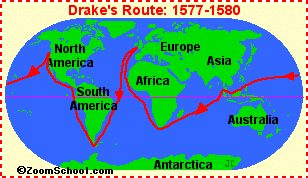 Sir Francis Drake (1545-1596) was a British explorer, slave-trader, privateer (a pirate working for a government) in the service of England, mayor of Plymouth, England, and naval officer (he was an Admiral). Drake led the second expedition to sail around the world in a voyage lasting from 1577 to 1580 (Magellan led the first voyage around the world).
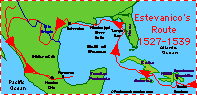
Estevanico (pronounced es-tay-vahn-EE-co), also called Estevan, Esteban, Estebanico, Black Stephen, and Stephen the Moor (1500?-1539) was a Muslim slave from northern Africa (Azamor, Morocco) who was one of the early explorers of the southwestern United States.
Father Francisco Tomás Garcés, (April 12, 1738 - July 18, 1781) was a Spanish Franciscan priest who was a missionary and explorer. Father Garces explored the southwestern part of North America, including what is now Arizona, U.S., southern California, and the Gila and Colorado rivers (including the western Grand Canyon). He visited Hopi and Havasupai Indians, learning much about the area.
From 1768 to 1776, Father Garces explored with Juan Bautista de Anza and alone with native guides. He and Juan Díaz died in a Yuman uprising in the area where the Colorado and Gila rivers meet; they were trying to find a route from Sonora, Mexico to California.
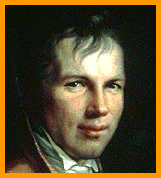
Baron Alexander von Humboldt (1769-1859) was a Prussian naturalist and explorer who explored much of Central and South America. Humboldt and his friend, the French botanist Aime Bonpland, explored the coast of Venezuela, the Amazon and Orinoco Rivers, and much of Peru, Ecuador, Colombia and Mexico (1799-1805).
On their many expeditions, Humboldt and Bonpland collected plant, animal, and mineral specimens, studied electiricity, did extensive mapping of northern South America, climbed mountains, observed astronomical phenomena, and performed many scientific observations.

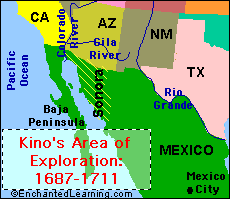 Father Eusebio Francisco Kino, S. J., (Aug. 10, 1645 - March 15, 1711) was a Jesuit priest, missionary, explorer, map-maker, mathematician, and astronomer. Kino was a missionary who founded many missions and explored areas in southwestern North America (Pimería Alta), including areas in what are now northern Sonora (Mexico), southern California (USA) and southern Arizona (USA).
Juan Perez (ca.1725-1775) was a Spanish navigator who explored the northwest coast of North America. He sailed from Port San Blas, Mexico, up the coast of North America in 1774, in a ship named the Santiago. He had been ordered to sail as far north as Alaska (60 degrees north latitude), but only made it to what is now British Columbia, because of bad weather. He anchored his 82-foot ship off the Queen Charlotte Islands, by northern Vancouver Island. On two occasions, Native Americans canoed to Perez’s ship to trade and invite Perez ashore. Perez never went ashore and so wasn’t able to claim the land for Spain. He made detailed reports of the shoreline and his reports prompted later expeditions.
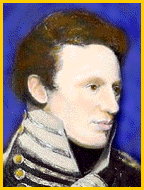
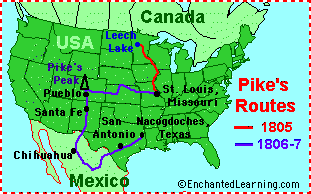 Zebulon Montgomery Pike (January 5, 1779 - April 27, 1813) was an American explorer and military officer (he served in the War of 1812). Pike tried to find the source of the Mississippi River; he also explored the Rocky Mountains and southwestern North America. Pike’s Peak in Colorado is named for him.

Vincente Yáñez Pinzon (1460? - 1523?) was a Spanish explorer and navigator who sailed with Christopher Columbus on his first voyage to the New World, as captain of the Niña. His older brother, Martin Pinzon, was captain of the Pinta and the co-owner of both the Nina and the Pinta.
In 1499, Vincente Pinzon sailed to the Brazilian coast (at a cape he named Santa María de la Consolación). From there, he sailed northwest to the Amazon River, whose mouth he explored. He sailed north to northeastern Venezuela (to the Gulf of Paria) and then returned to Spain.
In 1508, he sailed to the New World twice with Juan Díaz de Solís, trying to find a a passage to the Spice Islands. They sailed to Central America, but the exact locations of these explorations are unknown (they either sailed to Honduras and the Yucatán peninsula or to Venezuela and Brazil).
Father Junipero Serra (1713-1784) was a Spanish Franciscan priest who traveled to Mexico in 1749 to do missionary work and perform other church functions.
In 1767, Serra went north from Mexico to what is now California and continued his missionary work, converting native Americans zealously (sometimes forcibly). He founded many missions in California, including the Mission of San Diego (founded in 1769) and 8 other missions, which were often built by the forced labor of Indians who were rounded up by Spanish soldiers. The death rate of Native Americans at Serra’s missions was tremendously high; many more died than were baptized. Serra also helped an expedition in locating San Francisco.
Father Serra was well-known for his acts of mortification of the flesh; he wore heavy hair shirts with sharp wires that rubbed against his skin, he whipped himself, and he burned himself with candles. Although the Catholic church bestowed sainthood on Serra in 1988 for his missionary work, his cruelty and the tremendously negative effect he had on Native Americans have made him a very controversial saint to many people.
Sebastián Vizcaíno (1550?-1628?) was a Spanish nobleman, explorer and merchant. In 1602, Vizcaino sailed up te coast of California in three ships at the request of King Phillip II of Spain. Vizcaino named Monterey Bay (named for the viceroy Conde de Monterey who sponsored this voyage) and San Diego (Vizcaino arrived there on the feast day of San Diego de Alcala, November 12). One ship sailed as far north as Oregon. Vizcaino also named San Clemente, Catalina, Santa Barbara, Point Concepcion, Carmel, Monterey, La Paz, and Ano Nuevo. Most of the crew died from scurvy (a lack of vitamin C). Although Cabrillo had already named many of these place, Vizcaino published well-read accounts of his voyages, and his names were used. Vizcaino’s earlier attempt, in 1596, to colonize southern California failed; it was 150 years before other Europeans came to California. Vizcaíno travelled to Japan in 1610, meeting with the retired shogun Tokugawa Ieyasu in Sumpu (now Shizuoka); Vizcaino returned to Mexico with a mission led by Hasekura Tsunenaga, who both hoped to open trade between Mexico/Spain and Japan (but the mission failed after the expelled Japanese Christian priests from Japan, angering the Spanish). Sebastián Vizcaíno Bay, a bay of the Pacific Ocean, in the western Baja California peninsula, Mexico, is named for Vizcaino.