



The windshield wiper was invented by Mary Anderson in 1903 to help streetcars operate safely in the rain. In 1905 she patented her invention, which allowed the car operator to control the external, swinging arm wipers from within the car. Windshield wipers became standard equipment on cars a decade later. Anderson was from Alabama, USA.
The Apgar scale is a standardized scale that is used to determine the physical status of an infant at birth. This simple, easy-to-perform test was devised in 1953 by Dr. Virginia Apgar (1909-1974), a professor of anesthesia at the New York Columbia-Presbyterian Medical Center. The Apgar scale is administered to a newborn at one minute after birth and five minutes after birth. It scores the baby’s heart rate, respiration, muscle tone, reflex response, and color. This test quickly alerts medical personnel that the newborn needs assistance.
Dr. Virginia Apgar (1909-1974), a professor of anesthesiology at the New York Columbia-Presbyterian Medical Center, devised the Apgar Scale in 1953. The Apgar scale is a simple, easy-to-perform, standardized scale that is used to determine the physical status of an infant at birth. The Apgar scale is administered to a newborn at one minute after birth and five minutes after birth. It scores the baby’s heart rate, respiration, muscle tone, reflex response, and color. This test quickly alerts medical personnel that the newborn baby needs assistance.
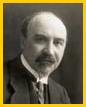
BaekelandLeo Hendrik Baekeland (November 14, 1863 - February 23, 1944) was a Belgian-born American chemist who invented Velox photographic paper (1893) and Bakelite (1907), an inexpensive, nonflammable, versatile, and very popular plastic.

Alexander Graham Bell (March 3, 1847, Edinburgh, Scotland - August 2, 1922, Baddek, Nova Scotia) invented the telephone (with Thomas Watson) in 1876. Bell also improved Thomas Edison’s phonograph. Bell invented the multiple telegraph (1875), the hydroairplane, the photo-sensitive selenium cell (the photophone, a wireless phone, developed with Sumner Tainter), and new techniques for teaching the deaf to speak. In 1882, Bell and his father-in-law, Gardiner Hubbard, bought and re-organized the journal “Science.” Bell, Hubbard and others founded the National Geographic Society in 1888; Bell was the President of the National Geographic Society from 1898 to 1903.
Dr. Solomon A. Berson (1919-1972) and Dr. Rosalyn Sussman Yalow (1921- ) co-invented the radioimmunoassay (RIA) in 1959. The radioimmunoassay is a method of chemically analyzing human blood and tissue that is used diagnose illness (like diabetes). RIA revolutionized diagnoses because it used only a tiny sample of blood or tissue and is a relatively inexpensive and simple test to perform. Blood banks use RIA to screen blood; RIA is used to detect drug use, high blood pressure, infertility, and many other conditions and diseases. For inventing RIA, Yalow won the Nobel Prize in Medicine in 1977 (Yalow accepted for Berson, who died in 1972). Yalow and Berson did not patent the RIA; instead they allowed the common use of RIA to benefit human health.

Katherine J. Blodgett (1898-1979) was an American physicist and inventor who invented a micro-thin barium stearate film that makes glass completely nonreflective and “invisible” (patent #2,220,660, March 16, 1938). Blodgett’s invention has been used in eyeglasses, camera lenses, telescopes, microscopes, periscopes, and projector lenses. Blodgett also invented a gauge that measured the thickness of this type of coating (which can be only a few molecules thick), called a “color gauge.”

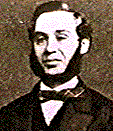 Levi Strauss (1829-1902) was an entrepreneur who invented and marketed blue jeans. Trained as a tailor in Buttenheim, Bavaria, Germany, Strauss went to San Francisco, USA from New York in 1853. Strauss sold dry goods, including tents and linens to the 49ers (the people who came to the California gold rush, which began in 1849). In 1873, Strauss and Jacob Davis, a Nevada tailor, patented the idea (devised by Davis) of using copper rivets at the stress points of sturdy work pants. Early levis, called “waist overalls,” came in a brown canvas duck fabric and a heavy blue denim fabric. The duck fabric pants were not very successful, so were dropped early on. His business became extremely successful (and still is), revolutionizing the apparel industry.

Luther Burbank (1849-1926) was an American plant breeder who developed over 800 new strains of plants, including many popular varieties of potato, plums, prunes, berries, trees, and flowers. One of his greatest inventions was the Russet Burbank potato (also called the Idaho potato), which he developed in 1871. This blight-resistant potato helped Ireland recover from its devastating potato famine of 1840-60. Burbank also developed the Flaming Gold nectarine, the Santa Rosa plum, and the Shasta daisy. Burbank was raised on a farm and only went to elementary school; he was self-educated. Burbank applied the works of Charles Darwin to plants. Of Darwin’s The Variation of Animals and Plants under Domestication, Burbank said, “It opened up a new world to me.”

The word game Scrabble® was developed by Alfred Mosher Butts in 1948. James Brunot did some rearranging of the squares and simplified the rules. A copyright was granted on December 1, 1948. Alfred Butts had been an architect, but lost his job in 1931 (during the depression). He then began developing games, including Lexico, Criss-Crosswords, and them Scrabble®. After about 4 years of paltry sales, Scrabble® became a hit.
Chester Floyd Carlson (1906-1968) invented xerography (which means “dry writing” in Greek) in 1938. Xerography makes paper copies without using ink (hence its name). In this process, static electricity charges a lighted plate; a plastic powder (called toner) is applied to the areas of the page to remain white.
Chester F. Carlson was born in Seattle, Washington, USA. As a teenager, Carlson supported his invalid parents by publishing a chemical journal. After attending Cal Tech in physics, Carlson worked at an electronics firm. Carlson later experimented at home to find an efficient way of copying pages. He succeeded in 1938, and marketed his revolutionary device to about 20 companies before he could interest any. The Haloid Company (later called the Xerox Corporation) marketed it, and photocopying eventually became common and inexpensive.
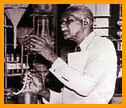
 George Washington Carver (1865?-1943) was an American scientist, educator, humanitarian, and former slave. Carver developed hundreds of products from peanuts, sweet potatoes, pecans, and soybeans; his discoveries greatly improved the agricultural output and the health of Southern farmers. Before this, the only main crop in the South was cotton. The products that Carver invented included a rubber substitute, adhesives, foodstuffs, dyes, pigments, and many other products.
For a cloze (fill-in-the-blank) activity on Carver, click here.
Celluloid is a plastic made from cellulose (it is derived from plants). This very flammable material was invented in 1869 by the American inventor John Wesley Hyatt (it was invented to be a substitute for the elephant ivory used for billiard balls). Celluloid was one the first plastics invented; it can be damaged by moisture.
The first dishwasher was patented in 1850 by Joel Houghton; his machine was a hand-turned wheel that splashed water on dishes - unfortunately, it wasn’t very effective at washing dishes. The first working automatic dishwasher was invented by Mrs. Josephine Garis (W. A.) Cochran, of Shelbyville, Illinois, in 1889. Her dishwasher was a wooden tub with a wire basket in it - the dishes went in the basket, and rollers rotated the dishes. As a handle on the tub was turned, hot, soapy water was sprayed into the tub, cleaning the dishes. Cochran’s machine was first shown at the 1893 World’s Fair in Chicago, Illinois. At first, her machine was only bought by some restaurants and hotels. Cochran’s small company was eventually associated with the KitchenAid company. The dishwasher didn’t become widespread as a labor-saving machine until the 1960s.
The potato chip was invented in 1853 by George Crum. Crum was a Native American/African American chef at the Moon Lake Lodge resort in Saratoga Springs, New York, USA. French fries were popular at the restaurant and one day a diner complained that the fries were too thick. Although Crum made a thinner batch, the customer was still unsatisfied. Crum finally made fries that were too thin to eat with a fork, hoping to annoy the extremely fussy customer. The customer, surprisingly enough, was happy - and potato chips were invented!
For more information on George Crum and potato chips, click here.
Thomas Davenport (July 9, 1802 -July 6, 1851) was an American blacksmith and inventor who established the first commercially successful electric streetcar. Davenport, from Vermont, invented an electric motor in 1834 and began a small electric railway in 1835. He patented a device for “Improvements in propelling machinery by magnetism and electromagnetism” in 1837 (his electric railway). Davenport later started a workshop in New York City, New York, and published a journal on electromagnetism (it was printed on a press that was powered by motors which he devised).

Bandages for wounds had been around since ancient times, but an easy-to-use dressing with an adhesive was invented by Earle Dickson (a cotton buyer at the Johnson & Johnson company). Dickson perfected the BAND-AID® in 1920, making a small, sterile adhesive bandage for home use. Dickson invented the BAND-AID® for his wife, who had many kitchen accidents and needed an easy-to-use wound dressing. Dickson was rewarded by the Johnson & Johnson company by being made a vice-president of the company.

Marion Donovan (1917-1998) was an American mother, inventor, and architect who invented the disposable diaper in 1950. Her first leak-proof diaper were fast-selling “Boaters,” plastic-lined cloth diapers (diapers lined with pieces cut from a shower curtain, and later with surplus parachute nylon). Donovan then developed a completely disposable diaper. She was unsuccessful at selling this invention to established manufacturers, so she started her own company, which she later sold. Donovan produced many other consumer-based inventions and held more than a dozen patents
Clatonia Joaquin Dorticus was an African-American inventor who received many patents. He invented an apparatus for applying dyes to the sides of the soles and heels of shoes (patent # 535,820, March 19, 1895), a machine for embossing (contouring the paper of) photographs (patent # 537,442, April 16, 1895), a device that helped develop photographs (patent # 537,968, April 23, 1895), and a leak stopper for hoses (patent # 629,315, July 18, 1899).
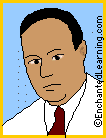
Dr. Charles Richard Drew (1904-1950) was an American medical doctor and surgeon who started the idea of a blood bank and a system for the long-term preservation of blood plasma (he found that plasma kept longer than whole blood). His ideas revolutionized the medical profession and have saved many, many lives.
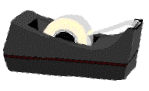
Richard G. Drew (1899-1980) invented masking tape and clear adhesive tape (also called cellophane tape or Scotch tape). Drew was an engineer for the 3M company (the Minnesota Mining and Manufacturing).
Drew’s first tape invention was a masking tape made for painters in 1923 (this tape was designed to help painters paint a straight border between two colors). This early masking tape was a wide paper tape with adhesive on only the edges of the tape - not in the middle. Drew made an improved tape called Scotch (TM) Brand Cellulose Tape in 1930. This tape was a clear, all-purpose adhesive tape that was soon adopted worldwide. The first tape dispenser with a built-in cutting edge was invented in 1932 by John A. Borden, another 3M employee.

George Eastman (1854-1932) was an American inventor who made many improvements in photography. Eastman invented the dry plate method in 1879; this was an improvement in the wet plate process photographic process). He founded the Eastman Dry Plate company in 1881, located in Rochester, New York. Eastman and William Walker invented flexible roll film in 1882, eliminating the necessity of using cumbersome glass plates for photography. Eastman produced the first simple, all-purpose, fixed-focus camera in 1888, which sold for $25.00; this was the first KODAK Camera . By 1900, Eastman Kodak was producing a camera that cost only one dollar. Early cameras took round pictures. To get the film developed, the photographer had to send the entire camera to the Rochester factory. The company name was changed to Eastman Kodak Company in 1892, and is still one of the largest photographic companies in the world.
ENIAC stands for “Electronic Numerical Integrator and Computer.” It was one of the first all-purpose, all-electronic digital computers. This room-sized computer was built by the physicist John William Mauchly (Aug. 30, 1907 - Jan. 8, 1980) and the electrical engineer John Presper Eckert, Jr. (April 9, 1919 - June 3, 1995) at the University of Pennsylvania. They completed the machine in November, 1945.
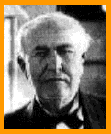
 Thomas Alva Edison (1847-1931) was an American inventor (also known as the Wizard of Menlo Park) whose many inventions revolutionized the world. His work includes improving the incandescent electric light bulb and inventing the phonograph, the phonograph record, the carbon telephone transmitter, and the motion-picture projector.
Edison’s first job was as a telegraph operator, and in the course of his duties, he redesigned the stock-ticker machine. The Edison Universal Stock Printer gave him the capital ($40,000) to set up a laboratory in Menlo Park, New Jersey, to invent full-time (with many employees).
Edison experimented with thousands of different light bulb filaments to find just the right materials to glow well, be long-lasting, and be inexpensive. In 1879, Edison discovered that a carbon filament in an oxygen-free bulb glowed but did not burn up for quite a while. This incandescent bulb revolutionized the world.
For more information on Edison, click here.
Gertrude Belle Elion (January 23, 1918 - February 21, 1999) was a Nobel Prize winning biochemist who invented many life-saving drugs, including 6-mercaptopurine (Purinethol) and 6-thioguanine (which fight leukemia), Imuran, Zovirax, and many others. Elion worked at Burroughs-Wellcome (now called Glaxo Wellcome) for decades (beginning in 1944) with George Hitchings and Sir James Black, with whom she shared the Nobel Prize. She is named on 45 patents for drugs and her work has saved the lives of thousands of people.

The popsicle was invented by 11-year-old Frank Epperson in 1905. Epperson (1894-?) lived in San Francisco, California. Epperson had left a fruit drink out overnight (with a stirrer in it), and it froze, making a new treat. His frozen treat was originally called the Epsicle. Epperson got a patent on his “frozen ice on a stick” many years later, in 1923. The Epsicle was later renamed the popsicle. Epperson also invented the twin popsicle (with two sticks so it could be shared by two children), Fudgsicle, Creamsicle and Dreamsicle.

Philo Taylor Farnsworth (1906-1971) was an American inventor. Farnsworth invented many important components of the television, including power, focusing systems, synchronizing the signal, contrast, controls, and scanning. He also invented a radar system, a cold cathode ray tube, a new type of baby incubator, and the first electronic microscope. Farnsworth held over 300 patents.
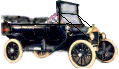
Henry Ford (1863-1947) was an American engineer and industrialist who used the first conveyor belt-based assembly-lines in his car factory, revolutionizing factory production. Ford manufactured affordable cars and paid high wages to his factory workers, allowing workers to buy the cars they made. After early work as a machinist, Ford built a gasoline engine in 1893. In 1896, Ford built a “horseless carriage,” which he called the “Quadricycle,” which means “four wheels” (others, including Charles Edgar and J. Frank Duryea, Elwood Haynes, Hiram Percy Maxim, and Charles Brady King had built earlier “horseless carriage”). In 1899, Ford formed the Detroit Automobile Company (which was later called the Henry Ford Company and then the Cadillac Motor Car Company). Ford introduced the Model T in October 1908; it was a great success (every Model T was painted black). Ford introduced conveyor belt-based assembly-line factory production and a $5 daily wage in 1913-14 in Ford’s Highland Park, Michigan plant (primitive assembly line production had been started in 1901 by Ransome Eli. Olds, another early car-maker). This type of production greatly reduced the amount of time taken to put each car together (93 minutes for a Model T) from its parts, reducing production costs.

 Benjamin Franklin (January 17, 1706-April 17, 1790) was an American statesman, writer, printer, and inventor. Franklin experimented extensively with electricity. In 1752, his experiments with a kite in a thunderstorm (never do this, many people have died trying it!) led to the development of the lightning rod. Franklin started the first circulating library in the colonies in 1731. He also invented bifocal glasses and the Franklin stove. The idea of daylight savings time was first proposed by Benjamin Franklin in 1784.
Frances Gabe (actually, Frances G. Bateson) (1915-) invented and patented the self-cleaning house. Gabe, who lives in Newberg, Oregon, USA, disliked housework intensely. She designed and lives in a house in which each room has a 10-inch square, “Cleaning/ Drying/ Heating/ Cooling” device on the ceiling. To clean a room, all you have to do is push a button in a room, and the cleaning unit sends a powerful spray of soapy water around the room. It then rinses and blow-dries the room. Each room has a slightly-sloping floor, so the water would drain well. Frances stored valuable objects (and things that should not get wet) under glass. The house also has self-cleaning sinks, bathtubs and toilets. Her cupbord doubles as a dishwasher and her clothes are cleaned, dried and stored while hanging in the closet. Gabe holds 68 patents. Frances said, “Housework is a thankless, unending job, a nerve-tangling bore. Who wants it? Nobody! With my jaw set hard I was determined there had to be a better way!”
Pantyhose was invented in 1959 by Allen Gant of North Carolina, USA, in 1959. This new undergarment became popular as miniskirts were the fashion and soon came to replace nylon stockings held up with a garter belt (short skirts were not long enough to hide the bottom of the garter belt). Gant was associated with the Glen Raven Mills textile mill (he was a descendant of the founder of the mill, John Gant), the company that first manufactured pantyhose.
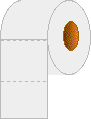
Joseph Gayetty invented toilet paper in 1857. His new toilet paper was composed of flat sheets. Before Gayetty’s invention, people tore pages out of mail order catalogs - before catalogs were common, leaves were used. Unfortunately, Gayetty’s invention failed. Walter Alcock (of Great Britain) later developed toilet paper on a roll ( instead of in flat sheets). Again, the invention failed.
In 1867, Thomas, Edward and Clarence Scott (brothers from Philadelphia, Pennsylvania, USA) were successful at marketing toilet paper that consisted of a small roll of perforated paper . They sold their new toilet paper from a push cart - this was the beginning of the Scott Paper Company.
The Q-tip was invented in the 1920’s Leo Gerstenzang (a Polish-born American). His wife had used a toothpick with cotton stuck on the end to clean their baby’s ears, and Leo invented Q-tips to replace her jury-rigged invention. Gerstenzang’s original Q-tips consisted of a wooden stick swathed in cotton at both ends; much later, the wood was replaced by white cardboard. Gerstenzang started the Infant Novelty Company to sell Q-tips (which he then called Baby Gays); in 1926, he changed the name of his product to Q-Tips® Baby Gays. The Q stood for “quality”. Eventually, the name changed to Q-tips. Doctors today advise that you should not use Q-tips to clean inside your ears. Q-tips, however, have many other uses, including cleaning small areas (like jewelry or the space between computer keys), applying glue, spreading paint, etc.

Robert Hutchings Goddard (October 5, 1882-August 10, 1945) was an American physicist and inventor who is known as the father of modern rocketry. In 1907, Goddard proved that a rocket’s thrust can propel it in a vacuum. In 1914, Goddard received two U.S. patents: for liquid-fueled rockets and for two- to three-stage rockets that use solid fuel. In 1919, Goddard wrote a scientific article, “A Method of Reaching Extreme Altitudes,” describing a high-altitude rocket; it was published in a Smithsonian report. Goddard’s many inventions were the basis upon which modern rocketry is based.
After many years of failed attempts and public ridicule, Goddard’s first successful rocket was launched on March 16, 1926 from a relative’s farm in Auburn, Massachusetts. It was a liquid-fueled 10-ft. rocket that he called Nell. The flight lasted 2 1/2 seconds; the rocket flew a distance of 184 feet and achieved an altitude of 41 feet.
Goddard soon moved to Roswell, New Mexico, where he developed more sophisticated multi-stage rockets, rockets with fins (vanes) to steer them (1932), a gyro control device to control the rocket (1932), and supersonic rockets (1935). In 1937, Goddard launched the first rocket with a pivotable motor on gimbals using his gyro control device. Altogether, Robert Goddard had 214 patents.
Sarah E. Goode was a businesswoman and inventor. Goode invented the folding cabinet bed, a space-saver that folded up against the wall into a cabinet. When folded up, it could be used as a desk, complete with compartments for stationery and writing supplies. Goode owned a furniture store in Chicago, Illinois, and invented the bed for people living in small apartments. Goode’s patent was the first one obtained by an African-American woman inventor (patent #322,177, approved on July 14, 1885).

Rear Admiral Grace Murray Hopper (1906 - 1992) was a US naval officer and mathematician who invented the computer compiler (called the A-O) in 1952. Her compiler revolutionized computer programming, automatically translating high-level instructions (easier to understand by people) into machine code (the cryptic, native language of the central processing unit). Hopper and a team developed the first user-friendly business programming language, COBOL (COmmon Business-Oriented Language). There is an unconfirmed story that Hopper determined than an error in the early Mark II computer was caused by a moth that was trapped in it; she then coined the term “computer bug.”
The first dishwasher was patented in 1850 by Joel Houghton; his machine was a hand-turned wheel that splashed water on dishes - unfortunately, it wasn’t very effective at washing dishes. The first working automatic dishwasher was invented by Mrs. Josephine Garis (W. A.) Cochran, of Shelbyville, Illinois, in 1889. Her dishwasher was a wooden tub with a wire basket in it - the dishes went in the basket, and rollers rotated the dishes. As a handle on the tub was turned, hot, soapy water was sprayed into the tub, cleaning the dishes. Cochran’s machine was first shown at the 1893 World’s Fair in Chicago, Illinois. At first, her machine was only bought by some restaurants and hotels. Cochran’s small company was eventually associated with the KitchenAid company. The dishwasher didn’t become widespread as a labor-saving machine until the 1960s.

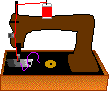 Elias Howe (1819-1867) was American inventor who patented an improved sewing machine in 1846. His revolutionary machine used two separate threads, one threaded through the needle, and one in a shuttle; it was powered by a hand crank. A sideways-moving needle with its eye at one end would pierce the fabric, creating a loop of thread on the other side; a shuttle would then push thread through the loop, creating a tight lock stitch. Earlier sewing machines used only one thread and a chain stitch that could unravel. Howe’s business did not thrive. Others, like Isaac Singer made slight modifications in the machine and built successful businesses. Howe sued those who had infringed on his patent and won royalties on all machines sold (he was paid $5.00 for each sewing machine sold). Howe died the year his patent expired.
Celluloid is a plastic made from cellulose (it is derived from plants). This very flammable material was invented in 1869 by the American inventor John Wesley Hyatt (it was invented to be a substitute for the elephant ivory used for billiard balls). Celluloid was one the first plastics invented; it can be damaged by moisture.
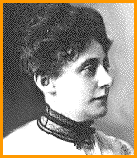
 Ida Henrietta Hyde (1857-1945) was an American physiologist who invented the microelectrode in the 1930’s. The microelectrode is a small device that electrically (or chemically) stimulates a living cell and records the electrical activity within that cell. Hyde was the first woman to graduate from the University of Heidelberg, to do research at the Harvard Medical School and to be elected to the American Physiological Society.

The engineer Richard James (1914-1974) invented the Slinky ™️ in 1943. This spring-toy came about by accident as James was developing springs to support sensitive equipment on ships. James invented a manufacturing machine that could make a Slinky ™️ from 80 feet of steel wire in 10 seconds. His wife Betty James (1918- ) named the Slinky ™️ and runs the company that produces it.

Karl Gothe Jansky (1905-1949) was an American radio engineer who pioneered and developed radio astronomy. In 1932, he detected the first radio waves from a cosmic source - in the central region of the Milky Way Galaxy.
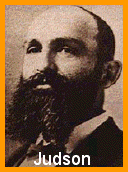
 Whitcomb L. Judson was an American engineer from Chicago, Illinois, who invented a metal zipper device with locking teeth in 1890. Judson patented his “clasp-locker’‘ on Aug. 29, 1893; later in 1893, he exhibited this new invention at the Chicago World’s Fair. He never succeeded in marketing his new device. The zipper was improved by the Swedish-American engineer, Gideon Sundbach, and was named by the B.F. Goodrich company in 1923. Judson died in 1909, before his device became commonly used and well-known
Dean Kamen is an American inventor who has invented many revolutionary devices and holds over 35 U.S. patents. He developed the portable medical infusion pump, which allows patients to receive medication, like insulin, away from the hospital, and has allowed diabetic women to carry and deliver babies much more safely. Kamen designed the iBot, a revolutionary wheelchair (that uses gyroscopes and computers) that the user “wears” - it allows increased mobility (it can even climb stairs) and improved social interaction (the user can “stand”). He also invented intravascular stents (devices that hold blocked arteries open) and the portable kidney dialysis machine, which has enabled kidney dialysis patients to avoid long hospital visits - they can do the dialysis themselves while they sleep. The Segway is a rechargable electric, single-person vehicle he invented.
Kamen founded an educational learning center for children called Science Enrichment Encounters (or “SEE”), and FIRST (“For the Inspiration and Recognition of Science and Technology”) which has a yearly robot competition for high school students.
Isabella Helen Lugoski Karle (1921- ) is a American physical chemist who invented new methods of X-ray Crystallography. She used electron diffraction and then x-ray diffraction to study the structure of molecules. Karle developed a three-dimensional modeling process, enabling her to identify and show the structures of hundreds of complex and important molecules (including alkaloids, ionophores, steroids, toxins, and peptides [amino acid compounds]). Because of Karle’s process, the number of published molecular analyses has jumped from about 150 to over 10,000 per year. Karle received the National Medal of Science in 1995. Karle is a senior scientist and head of the Naval Research Laboratory’s (NRL) x-ray diffraction section in the Laboratory for the Structure of Matter. Karle’s husband, Jerome Karle, is a Nobel Prize winner in chemistry.
Stephanie Louise Kwolek (1923- ) is an American chemist who discovered kevlar and many other para-aramid fibers. Kevlar (poly[p-phenyleneterephtalamide]) is a polymer fiber that is five times stronger than the same weight of steel. Kevlar is used in bullet-proof vests, helmets, trampolines, tennis rackets, and many other commonly-used objects.

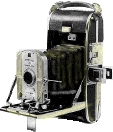 Edwin Herbert Land (1909-1991) was an American physicist and inventor who developed the first modern light polarizers (which eliminate glare) and other optical devices, investigated the mechanisms of color perception, and developed the instant photography process (the Polaroid camera). Land established the Polaroid Corp. in 1937.

Lewis Howard Latimer (1848-1928) was an African-American inventor who was a member of Edison’s research team, which was called “Edison’s Pioneers.” Latimer improved the newly-invented incandescent light bulb by inventing a carbon filament (which he patented in 1881).

The parking meter is a device for generating money from a parking spot. When you put money in the meter, you are allowed to park for a given amount of time - after that, you can be given a parking ticket.
The parking meter was invented by Carl C. Magee of Oklahoma City, Oklahoma, USA. The first parking meter was installed in Oklahoma City. Magee holds a patent (#2,118,318) for a “coin controlled parking meter,” filed on May 13, 1935 and issued on May 24, 1938.

The street letter drop mailbox with a hinged door that closed to protect the mail was invented by Philip B. Downing. Downing, an African-American inventor, patented his new device on October 27, 1891 (US Patent # 462,093).
ENIAC stands for “Electronic Numerical Integrator and Computer.” It was one of the first all-purpose, all-electronic digital computers. This room-sized computer was built by the physicist John William Mauchly (Aug. 30, 1907 - Jan. 8, 1980) and the electrical engineer John Presper Eckert, Jr. (April 9, 1919 - June 3, 1995) at the University of Pennsylvania. They completed the machine in November, 1945.
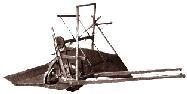
Cyrus Hall McCormick (February 15, 1809 - May 13, 1884) was an American inventor (of Irish descent) who developed the mechanical reaper. His new machine combined many of the steps involved in harvesting crops, greatly increased crop yields, decreased the number of field hands needed for the harvest, lowered costs, and revolutionized farming.
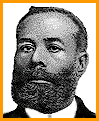
Elijah McCoy (1843 or 1844-1929) was a mechanical engineer and inventor. McCoy’s high-quality industrial inventions (especially his steam engine lubricator) were the basis for the expression “the real McCoy,” meaning the real, authentic, or high-quality thing.
Play-Doh, a popular children’s modeling clay, was invented by Noah W. McVicker and Joseph S. McVicker. They patented Play-Doh in 1956 (patent # 3,167,440). The original Play-Doh was sold in only one color, off- white. Eventually, many colors were marketed. Over 700 million pounds of Play-Doh have been sold, but the formula is still a secret.
The push pin (“a thumbtack with an elongated handle that makes it easier to put in and remove”) was invented by the Pennsylvanian inventor Edwin Moore in 1900. Moore started a company producing these useful pins in 1900. After years of growing, his company incorporated on July 19, 1904, and was called the “Moore Push-Pin Company.” The company 1912 through 1977, the Company was located in Germantown, Pennsylvania.
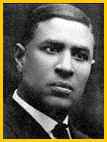
Garrett Augustus Morgan (March 4, 1877 - August 27, 1963), was an African-American inventor and businessman. He was the first person to patent a traffic signal. He also developed the gas mask (and many other inventions). Morgan used his gas mask (patent No. 1,090,936, 1914) to rescue miners who were trapped underground in a noxious mine. Soon after, Morgan was asked to produce gas masks for the US Army.
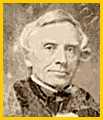
Samuel Finley Breese Morse (1791-1872) was an American inventor and painter. After a successful career painting in oils (first painting historical scenes and then portraits), Morse built the first American telegraph around 1835 (the telegraph was also being developed independently in Europe).
A telegraph sends electrical signals over a long distance, through wires. In 1830, Joseph Henry (1797-1878) made the first long-distance telegraphic device - he sent an electric current for over a mile on wire that activated an electromagnet, causing a bell to ring.
Morse patented a working telegraph machine in 1837, with help from his business partners Leonard Gale and Alfred Vail. Morse used a dots-and-spaces code for the letters of the alphabet and the numbers (Morse Code was later improved to use dots, dashes and spaces: for example E is dot, T is dash, A is dot-dash, N is dash-dot, O is dash-dash-dash, I is dot-dot, S is dot-dot-dot, etc.). By 1838, Morse could send 10 words per minute. Congress provided funds for building a telegraph line between Washington D.C. and Baltimore, Maryland, in 1843. Morse sent the first telegraphic message (from Washington D.C. to Baltimore) on May 24, 1844; the message was: “What hath God wrought?” The telegraph revolutionized long-distance communications.
The medicine ball is a weighed ball used in strength training; medicine balls range from 2 to 60 pounds in weight. The medicine ball was invented by William “Iron Duke” Muldoon, a nineteenth-century wrestling champion and boxing trainer.
Liquid Paper is a quick-drying, paper-colored (white) liquid that is painted onto paper to correct printed material. Liquid Paper was invented in 1951 by Bessie Nesmith (1922-1980). It was based on white tempera paint (Nesmith was also an artist). Nesmith was a secretary in Texas, USA, before the time of word processors. She began selling her vastly popular invention, and soon ran the very successful Liquid Paper company. Her son, Michael Nesmith, was a member of the rock group called the Monkees.

Elisha Graves Otis (1811-1861) was an American mechanic and inventor. Otis invented the elevator brake, which greatly improved the safety of elevators. He used a ratchet on a spring to catch the elevator in the event of an accident (like a broken cable). In 1854, at the Crystal Palace Exposition in New York, Otis demonstrated how safe his elevator was by cutting the elevator’s cable with an ax, and the elevator car stayed where it was in the shaft. Otis’ invention spurred the development of skyscrapers, changing the look of cities around the world forever. Otis also invented a railway safety brake and improvements to turbine engines and brass bed frames.
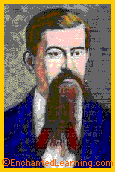
Dr. John Stith Pemberton (1830-1888) was an American pharmacist, soldier, and inventor. He invented Coca-Cola on May 8th, 1886 in Atlanta, Georgia, USA. He had invented many syrups, medicines, and elixirs before, including a very popular drink called French Wine of Coca, which contained French Bordeaux wine, coca leaves, and caffeine (from the kola nut).
When Atlanta banned alcohol consumption in 1885, Pemberton had to change the formula of his French Wine of Coca, omitting the French wine. He added sugar, citric acid and essential oils of many fruits to the drink, and the original Coca-Cola was created. It was named for its main ingredients, coca leaves and the kola nut. Coca-Cola quickly became a very popular soda fountain drink.
Pemberton became partners with Frank Robinson and David Roe, but the partners soon began to quarrel and Pemberton soon sold his interest in Coca-Cola. The formula for Coca-Cola is a closely-guarded secret.
Jesse W. Reno was an American inventor who developed the first escalator in 1891. An escalator is a moving stairway that helps people move easily from floor to floor in building. On his “inclined elevator,” passengers rode on an wedge-shaped supports attached to a conveyor belt at an incline of about 25 degrees. The original elevator had a stationary handrail (which was soon replaced with a moving handrail).
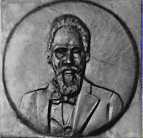
Norbert Rillieux (March 17, 1806-October 8, 1894) was an African-American inventor and engineer who invented a device that revolutionized sugar processing. Rillieux’s multiple effect vacuum sugar evaporator (patented in 1864) made the processing of sugar more efficient, faster, and much safer. The resulting sugar was also superior. His apparatus was eventually adopted by sugar processing plants all around the world.
The mechanical cash register was invented (and patented) in 1879 by James Ritty (1836-1918). Ritty was an American tavern keeper in Dayton, Ohio. He nicknamed his cash register the “Incorruptible Cashier,” and started the National Manufacturing Company to sell them. When a transaction was completed, a bell rang on the cash register and the amount was noted on a large dial on the front of the machine. During each sale, a paper tape was punched with holes so that the merchant could keep track of sales (at the end of the day, the merchant could add up the holes).
John H. Patterson (1844-1922) bought Ritty’s patent and his cash register company in 1884. Patterson renamed the Dayton, Ohio, company the National Cash Register Company. Patterson improved Ritty’s cash register by adding a paper tape that kept a printed record of all transactions.
In 1906, Charles F. Kettering (and employee of NCR) developed an electric cash register (Kettering later worked for General Motors and invented the electric car ignition).
The National Cash Register Company was later called NCR, until the company was bought by ATT in 1991; it was given back the name NCR in 1996, when it was split off from ATT.
Jonas Salk (1914-1995) was a research physician who formulated a vaccine against the devastating disease polio. Poliomyelitis, also called infantile paralysis, had crippled thousands of children during an epidemic that hit the world during the 1940’s and 1950’s. It is estimated that one of every 5,000 people (mostly children) fell victim to polio. Some victims were totally paralyzed and need to live in “iron lungs” (a large apparatus that helped the patient breathe). Salk’s developed his vaccine in 1947, while working at the University of Pittsburgh Medical School. The vaccine was made from killed polio virus. In 1955, after many trials of the new vaccine, the vaccine was made public, and put an end to the polio epidemic. Salk wrote many books, including: “Man Unfolding” (1972), “The Survival of the Wisest “(1973), “World Population and Human Values: A New Reality” (1981), and “Anatomy of Reality” (1983). When Salk died, he had been working on a vaccine for the AIDS virus.
Joseph Gayetty invented toilet paper in 1857. His new toilet paper was composed of flat sheets. Before Gayetty’s invention, people tore pages out of mail order catalogs - before catalogs were common, leaves were used. Unfortunately, Gayetty’s invention failed. Walter Alcock (of Great Britain) later developed toilet paper on a roll ( instead of in flat sheets). Again, the invention failed.
In 1867, Thomas, Edward and Clarence Scott (brothers from Philadelphia, Pennsylvania, USA) were successful at marketing toilet paper that consisted of a small roll of perforated paper . They sold their new toilet paper from a push cart - this was the beginning of the Scott Paper Company.

The electric iron was invented in 1882 by Henry W. Seeley, a New York inventor Seeley patented his “electric flatiron” on June 6, 1882 (patent no. 259,054). His iron weighed almost 15 pounds and took a long time to warm up.
Other electric irons had also been invented, including one from France (1882), but it used a carbon arc to heat the iron, a method which was dangerous.
Frances Gabe (actually, Frances G. Bateson) (1915-) invented and patented the self-cleaning house. Gabe, who lives in Newberg, Oregon, USA, disliked housework intensely. She designed and lives in a house in which each room has a 10-inch square, “Cleaning/ Drying/ Heating/ Cooling” device on the ceiling. To clean a room, all you have to do is push a button in a room, and the cleaning unit sends a powerful spray of soapy water around the room. It then rinses and blow-dries the room. Each room has a slightly-sloping floor, so the water would drain well. Frances stored valuable objects (and things that should not get wet) under glass. The house also has self-cleaning sinks, bathtubs and toilets. Her cupbord doubles as a dishwasher and her clothes are cleaned, dried and stored while hanging in the closet. Gabe holds 68 patents. Frances said, “Housework is a thankless, unending job, a nerve-tangling bore. Who wants it? Nobody! With my jaw set hard I was determined there had to be a better way!”
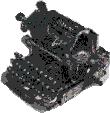
The first typewriter was invented in 1867 by the American printer and editor Christopher Latham Sholes (Feb. 14, 1819 - Feb. 17, 1890). Sholes’ prototype had the user hit a key (for each letter and number), which struck upward onto a flat plate, producing a carbon impression of the letter or number on the paper. He made the prototype using the key of an old telegraph transmitter. There was no way of spacing the letters, no carriage return, and no shift keys; these features would be added to later models.
Carlos Glidden and Samuel W. Soulé also worked in the Kleinstuber Machine Shop with Sholes, and they helped with his inventions. Their first patent was obtained on June 23, 1868. Sholes and Glidden sold the rights to their invention to the investor James Densmore, who eventually had the machine commercially manufactured. Their first commercial model was called the “Sholes & Glidden Type Writer,” and was later called the Remington typewriter. It was produced by the gunmakers E. Remington & Sons in Ilion, NY, from 1874-1878. The first author to submit a typed book manuscript was Mark Twain. Sholes’ typewriter was the beginning of a revolution in communication.
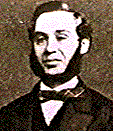
 Levi Strauss (1829-1902) was an entrepreneur who invented and marketed blue jeans. Trained as a tailor in Buttenheim, Bavaria, Germany, Strauss went to San Francisco, USA from New York in 1853. Strauss sold dry goods, including tents and linens to the 49ers (the people who came to the California gold rush, which began in 1849). In 1873, Strauss and Jacob Davis, a Nevada tailor, patented the idea (devised by Davis) of using copper rivets at the stress points of sturdy work pants. Early levis, called “waist overalls,” came in a brown canvas duck fabric and a heavy blue denim fabric. The duck fabric pants were not very successful, so were dropped early on. His business became extremely successful (and still is), revolutionizing the apparel industry.
Tea bags were invented by Thomas Sullivan around 1908. The first bags were made from silk. Sullivan was a tea and coffee merchant in New York who began packaging tea sample in tiny silk bags, but many customers brewed the tea in them (the tea-filled bag was placed directly into the boiling water where the tea brewed, instead of the traditional way of brewing loose tea in a teapot). Later tea bags were made of thin paper.
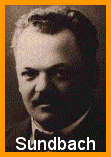
The zipper was improved by the Swedish-American engineer, Gideon Sundbach, in 1913. Sundbach was also successful at selling his “Hookless 2.” Sundbach sold these fasteners to the US Army, who put zippers on soldiers’ clothing and gear during World War I.
The word zipper was coined by B.F. Goodrich in 1923, whose company sold rubber galoshes equipped with zippers. Goodrich is said to have named them zippers because he liked the zipping sound they made when opened and closed.

The telephone (meaning “far sound”) is the most widely used telecommunications device. It was invented in 1876 by Alexander Graham Bell (with Thomas Watson). Bell patented his invention on March 1876 (patent No. 174,465). His device transmitted speech sounds over electric wires, and his idea has remained one of the most useful inventions ever made.
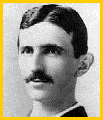
Nikola Tesla (1856-1943) was a Serbian-American inventor who developed the radio, fluorescent lights, the Tesla coil (an air-core transformer that generates a huge voltage from high-frequency alternating current), remote-control devices, and many other inventions; Tesla held 111 patents. Tesla developed and promoted the uses of alternating current (as opposed to direct current, which was promoted fiercely by Thomas Edison and General Electric). Tesla briefly worked with Thomas Edison. The unit of magnetic induction is named for Tesla; a tesla (abbreviated T) is equal to one weber per square meter.
John S. Thurman invented the gasoline powered vacuum cleaner (which he called the “pneumatic carpet renovator”) in 1899. His vacuum was patented on Oct. 3, 1899 (patent #634,042). It may have been the first motorized vacuum cleaner. Thurman had a run a horse drawn, door-to-door carpet vacuuming service in St. Louis, Missouri, USA, charging $4 per visit (which was a large amount of money at the time).

Ruth Graves Wakefield (1905-1977) invented chocolate chips (and chocolate chip cookies) in 1930. Wakefield ran the Toll House Inn in Whitman, Massachusetts. Her new cookie invention was called the “Toll House Cookie.” Her original cookies used broken-up bars of semi-sweet chocolate. Her cookbook, “Toll House Tried and True Recipes,” was published in 1940.
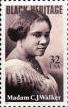
Madam C. J. Walker (December 23, 1867 - May 25, 1919) was an inventor, businesswoman and self-made millionaire. Sarah Breedlove McWilliams C. J. Walker was an African-American who developed many beauty and hair care products that were extremely popular. Madam Walker started her cosmetics business in 1905. Her first product was a scalp treatment that used petrolatum and sulphur. She added Madam to her name and began selling her new “Walker System” door-to-door. Walker soon added new cosmetic products to her line. The products were very successful and she soon had many saleswomen, called “Walker Agents,” who sold her products door to door and to beauty salons.

Lewis E. Waterman was an American inventor and insurance salesman who developed a relatively leak-proof fountain pen; he patented his new invention in 1884 and revolutionized writing. Before his fountain pen, pen tips had to be tipped into ink after every few words. Waterman put an ink reservoir in the pen above the pen’s metal nib (point). This reservoir would hold enough ink for a few pages of writing. There were many problems in developing the fountain pen, especially the difficulty of controlling the flow of the ink. Putting a sealed reservoir above the nib wouldn’t let the ink flow, but if it wasn’t sealed, all the ink would flow at once. Waterman used capillary action to replace the ink in the rubber sac with air so that the ink flowed smoothly but did not flow all at once. Also, the metals in the ink dissolved the steel pen nib, so Waterman used an iridium-plated gold nib. Waterman was also the first person to place a clip on the cap of the pen.
Eli Whitney (1765-1825) was an American inventor and engineer. Whitney invented the cotton gin and the idea of interchangeable parts. He patented the cotton gin, which revolutionized the cotton industry on March 14, 1794. The cotton gin is a machine that cleans cotton, removing its many seeds. Previously, this tedious job had been done by hand, using two combs. The cotton gin made much of the southern United States very rich, but cotton plantation owners rarely paid Whitney for the use of his invention, and Whitney went out of business. He never patented his later inventions (like his milling machine). Whitney also helped modernize the musket industry (and mass production in general) by introducing the idea of interchangeable parts in a manufacturing system.

The first working airplane was invented, designed, made, and flown by the Wright brothers, Wilbur Wright (1867-1912) and Orville Wright (1871-1948). Their “Wright Flyer” was a fabric-covered biplane with a wooden frame. The power to the two propellers was supplied by a 12-horsepower water-cooled engine. On December 17, 1903, the “Flyer” flew for 12 seconds and for a distance of 120 feet (37 m). The flight took place at Kitty Hawk, North Carolina, USA.
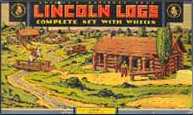
Lincoln Logs are a popular children’s toy building set that consists of interlocking notched logs. Children can easily make log cabins and other structures from the tiny wooden logs.
Lincoln Logs were invented in 1916 by John Lloyd Wright (1892-1972), an architect and one of the five children of the world-famous architect Frank Lloyd Wright. John patented his toy in 1920, and sold the logs through his toy company, the Red Square Toy Company. Playskool bought the rights to Lincoln Logs in 1943.
Dr. Chien-Shiung Wu (Shanghai, China, May 31, 1912 - New York, USA, February 16, 1997) was a nuclear physicist who studied beta-decay (a weak interaction in which one of the neutrons in the nucleus of an atom decays into a proton and an electron; the proton enters the nucleus, forming an isotope, and the electron is emitted as a beta-particle). In 1956, Madam Wu did experiments showing that parity is not conserved in weak interactions (demonstrating parity violation in the nuclear beta decay in cobalt 60). Her experiments supported T. D. Lee and C. N. Yang’s revolutionary idea that parity was not conserved in weak interactions (parity conservation had been a basic assumption in physics). Madam Wu worked on the Manhattan Project (a secret US project during World War 2 to develop an atomic bomb in order to defeat Hitler), developing a process for separating the uranium isotopes U235 and U238 by gaseous diffusion. She also helped develop more sensitive Geiger counters (devices that detect radiation). Madam Wu also studied the molecular changes in hemoglobin associated with sickle-cell anemia.

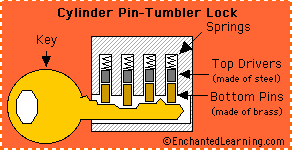 Linus Yale Jr. (1821-1868) was an American mechanical engineer and manufacturer who developed the cylinder pin-tumbler lock (and other key and combination locks). Yale’s father, Linus Yale, had invented an earlier pin-tumbler lock in 1848; the son’s lock used a smaller, flat key with serrated edges (like the ones we still use today). There is no connection between Linus Yale and Yale University.
Dr. Solomon A. Berson (1919-1972) and Dr. Rosalyn Sussman Yalow (1921- ) co-invented the radioimmunoassay (RIA) in 1959. The radioimmunoassay is a method of chemically analyzing human blood and tissue and is used diagnose illness (like diabetes). RIA revolutionized diagnoses because it uses only a tiny sample of blood or tissue and is a relatively inexpensive and simple test to perform. Blood banks use RIA to screen blood; RIA is used to detect drug use, high blood pressure, infertility, and many other conditions and diseases. For inventing RIA, Yalow won the Nobel Prize in Medicine in 1977 (Yalow accepted for Berson, who died in 1972). Yalow and Berson did not patent the RIA; instead they allowed the common use of RIA to benefit human health.

Frank J. Zamboni (1901-1988) was an inventor and mechanic who invented the Zamboni Ice Resurfacing Machine in 1949. His machine is used in ice rinks to resurface marred ice. In 1939, Zamboni and his brother Lawrence built a 20,000-square-foot enclosed ice skating rink in Paramount, California, USA. Resurfacing the ice was a major problem, and took many men and assorted equipment. In 1942, Zamboni transformed a tractor to scrape and smooth the ice in a single pass. After years, he perfected his it, releasing his “Model A Zamboni Ice Resurfacer” in 1949, (patent #2,642,679). The Olympic medal-winner Sonja Henie was one of his first customers.