




The Razor scooter is a new and very popular foldable scooter. It was invented by a team of people at the J.D. Corp. (a company that sells aluminum bicycle parts and electric scooters in Changhua, Taiwan, Republic of China). Gino Tsai, the president of the company, wanted a way to get around his factory floors faster (he says that he is a slow walker and he needed a more efficient means of getting around). It took about 5 years for the team to develop their current model, which uses airplane-grade aluminum and polyurethane wheels. It was introduced in 1998 at the NSGA World Sports Expo, when Tsai scooted around the show, attracting the attention of Sharper Image Corp., who ordered the first Razor scooters. The scooters quickly became popular world-wide.
Safety matches were invented by Johan Edvard Lundstrom of Sweden in 1855. Lundstrom’s new match was the first simple and safe way to make a fire. His new safety match could only be lit by striking the match against the specially-prepared surface that came attached to the box. Lundstrom put red phosphorus on the rough striking paper (on the outside the match box); the other fire-starting chemicals were on the match’s head. Previous matches gave long-time users an ailment called “phossy jaw;” this was a painful and deadly disease caused by the older matchs’ yellow phosphorus that ate into the users’ jaws.

The safety pin was invented by Walter Hunt in 1849. Hunt 1795-1859) patented the safety pin on April 10, 1849 (patent No. 6,281). Hunt’s pin was made by twisting a length of wire. Hunt invented the safety pin in order to pay a debt of $15; he eventually sold the rights to his patent for $400.
Jonas Salk (1914-1995) was a research physician who formulated a vaccine against the devastating disease polio. Poliomyelitis, also called infantile paralysis, had crippled thousands of children during an epidemic that hit the world during the 1940’s and 1950’s. It is estimated that one of every 5,000 people (mostly children) fell victim to polio. Some victims were totally paralyzed and need to live in “iron lungs” (a large apparatus that helped the patient breathe). Salk’s developed his vaccine in 1947, while working at the University of Pittsburgh Medical School. The vaccine was made from killed polio virus. In 1955, after many trials of the new vaccine, the vaccine was made public, and put an end to the polio epidemic. Salk wrote many books, including: “Man Unfolding” (1972), “The Survival of the Wisest “(1973), “World Population and Human Values: A New Reality” (1981), and “Anatomy of Reality” (1983). When Salk died, he had been working on a vaccine for the AIDS virus.

The sandwich was invented by John Montagu, the 4th Earl of Sandwich (1718-1792). About 1762, he is reputed to have been too busy to have a formal meal, and instructed his cook to pack his meat inside the bread to save him time - and the sandwich was invented.
Antoine-Joseph (Adolphe) Sax (1814 - Feb. 4, 1894) was Belgian musical instrument manufacturer and musician (he played the clarinet) who invented the saxophone. Sax first exhibited his newly-invented woodwind instrument at the 1841 Brussels Exhibition, and patented it in 1846. Sax also invented the saxhorn (a family of bugles with 3 or 4 valves), which he first exhibited in 1844. For a printout on the saxophone, click here.
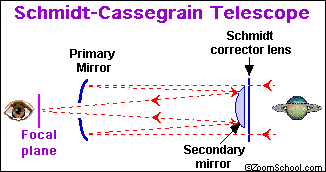 A Schmidt-Cassegrain telescope (SCT) is a wide-angle reflecting telescope with a correcting lens that minimizes spherical aberration and a concave mirror that receives light and focuses an image. A second mirror reflects the light through a gap in the primary mirror, allowing the eyepiece or camera to be mounted at the back end of the tube. The Cassegrain telescope (named for the French sculptor Sieur Guillaume Cassegrain) was developed in 1672; the correcting plate (a lens) was added in 1930 by the Estonian astronomer and lens-maker Bernard Schmidt (1879-1935).

Scissors were invented thousands of years ago (roughly 1500 B.C.) in ancient Egypt. Early scissors have been found in ancient Egyptian ruins. These early scissors were made from one piece of metal (unlike modern scissors, which are made from two cross-blades which pivot around a fulcrum). Modern cross-bladed scissors were invented in ancient Rome (roughly A.D. 100). Early scissors were used by clothes makers and barbers. Scissors were not in common use until much later, in the 1500’s (in Europe).
Joseph Gayetty invented toilet paper in 1857. His new toilet paper was composed of flat sheets. Before Gayetty’s invention, people tore pages out of mail order catalogs - before catalogs were common, leaves were used. Unfortunately, Gayetty’s invention failed. Walter Alcock (of Great Britain) later developed toilet paper on a roll ( instead of in flat sheets). Again, the invention failed.
In 1867, Thomas, Edward and Clarence Scott (brothers from Philadelphia, Pennsylvania, USA) were successful at marketing toilet paper that consisted of a small roll of perforated paper . They sold their new toilet paper from a push cart - this was the beginning of the Scott Paper Company.

The word game Scrabble® was developed by Alfred Mosher Butts in 1948. James Brunot did some rearranging of the squares and simplified the rules. A copyright was granted on December 1, 1948. Alfred Butts had been an architect, but lost his job in 1931 (during the depression). He then began developing games, including Lexico, Criss-Crosswords, and them Scrabble®. After about 4 years of paltry sales, Scrabble® became a hit.

The earliest known screwdriver dates from the 15th-century. Slotted screws (which were inserted with screwdrivers) were then used in knight’s armor. One is on display at the Metropolitan Museum of Art in New York City, New York.

The electric iron was invented in 1882 by Henry W. Seeley, a New York inventor Seeley patented his “electric flatiron” on June 6, 1882 (patent no. 259,054). His iron weighed almost 15 pounds and took a long time to warm up.
Other electric irons had also been invented, including one from France (1882), but it used a carbon arc to heat the iron, a method which was dangerous.
Frances Gabe (actually, Frances G. Bateson) (1915-) invented and patented the self-cleaning house. Gabe, who lives in Newberg, Oregon, USA, disliked housework intensely. She designed and lives in a house in which each room has a 10-inch square, “Cleaning/ Drying/ Heating/ Cooling” device on the ceiling. To clean a room, all you have to do is push a button in a room, and the cleaning unit sends a powerful spray of soapy water around the room. It then rinses and blow-dries the room. Each room has a slightly-sloping floor, so the water would drain well. Frances stored valuable objects (and things that should not get wet) under glass. The house also has self-cleaning sinks, bathtubs and toilets. Her cupbord doubles as a dishwasher and her clothes are cleaned, dried and stored while hanging in the closet. Gabe holds 68 patents. Frances said, “Housework is a thankless, unending job, a nerve-tangling bore. Who wants it? Nobody! With my jaw set hard I was determined there had to be a better way!”
 The first functional sewing machine was invented by the French tailor Barthélemy Thimonnier in 1830. Other tailors feared for their livelihood, and burnt his workshop down. Elias Howe was American inventor who patented an improved sewing machine in 1846. Howe’s revolutionary machine used two separate threads, one threaded through the needle, and one in a shuttle; it was powered by a hand crank. A sideways-moving needle with its eye at one end would pierce the fabric, creating a loop of thread on the other side; a shuttle would then push thread through the loop, creating a tight lock stitch. Earlier sewing machines used only one thread and a chain stitch that could unravel. Howe’s business did not thrive. Others, like Isaac M. Singer made slight modifications in the machine and built successful businesses. Howe sued those who had infringed on his patent and won royalties on all machines sold (he was paid $5.00 for each sewing machine sold). Howe died the year his patent expired.
The sextant is an astronomical instrument that is used to determine latitude for navigation. It does this by measuring angular distances, like the altitude of the sun, moon and stars. The sextant was invented independently in both England and America in 1731. The sextant replaced the astrolabe. The word sextant comes from the Latin word meaning “one sixth.”
The cat’s eye road reflector is a simple device that has saved countless lives. These inexpensive glass and rubber reflectors are set on the roadway at regular intervals, and help motorists see where the road is at night. Each of the cat’s eyes reflects oncoming light, acting like lights set into the road. This device was invented in 1933 by Percy Shaw, from Yorkshire, England. He invented it after he had been driving on a dark, winding road on a foggy night; he was saved from going off the side of the hill by a cat, whose eyes reflected his car’s lights. Shaw’s invention mimicked the reflectivity of a cat’s eyes. Because of his invention, Shaw was awarded the Order of the British Empire (“OBE”) by Queen Elizabeth of England in 1965.
The first typewriter was invented in 1867 by the American printer and editor Christopher Latham Sholes (Feb. 14, 1819 - Feb. 17, 1890). Sholes’ prototype had the user hit a key (for each letter and number), which struck upward onto a flat plate, producing a carbon impression of the letter or number on the paper. He made the prototype using the key of an old telegraph transmitter. There was no way of spacing the letters, no carriage return, and no shift keys; these features would be added to later models.
Carlos Glidden and Samuel W. Soulé also worked in the Kleinstuber Machine Shop with Sholes, and they helped with his inventions. Their first patent was obtained on June 23, 1868. Sholes and Glidden sold the rights to their invention to the investor James Densmore, who eventually had the machine commercially manufactured. Their first commercial model was called the “Sholes & Glidden Type Writer,” and was later called the Remington typewriter. It was produced by the gunmakers E. Remington & Sons in Ilion, NY, from 1874-1878. The first author to submit a typed book manuscript was Mark Twain. Sholes’ typewriter was the beginning of a revolution in communication.

Silk was first made by the Chinese about 4,000 years ago. Silk thread is made from the cocoon of the silkworm moth (Bombyx mori), a small moth whose caterpillar eats the leaves of the mulberry tree.
According to Chinese legend, the first silk thread was made when the Chinese Empress Si-Ling-Chi was sitting under a mulberry tree and a cocoon fell into her tea; she noticed the strong, silky threads of the cocoon uncoiling. She then developed the use of silk.
For more information on the development of silk, click here.
Silly putty was invented in 1943 by the General Electric engineer James Wright, who was trying to invent a synthetic rubber during World War 2. He made it from boric acid and silicone oil, which forms a weird polymerized compound. Wright could find no uses for this bouncy, gooey substance. Peter Hodgson, who worked in marketing, realized its future as a novelty toy in 1949, and it was a success. It was even taken to the moon in 1968 by the Apollo 8 Astronauts.

The Slinky ™️ was invented by the engineer Richard James (1914-1974) in 1943. This spring-toy came about by accident as James was developing springs to support sensitive equipment on ships. James invented a manufacturing machine that could make a Slinky ™️ from 80 feet of steel wire in 10 seconds. His wife Betty James (1918- ) named the Slinky ™️ and runs the company that produces it.
The first residential smoke alarm (also called a smoke detector) was designed in 1967 by BRK Electronics (this company would later sell the First Alert® brand of smoke detectors). These inexpensive, battery-operated devices received the Underwriters Laboratory approval in 1969. Smoke alarms have saved countless lives over the years, alerting people to fires.

The microwave oven was invented as an accidental by-product of war-time (World War 2) radar research using magnetrons (vacuum tubes that produce microwave radiation). In 1946, the engineer Dr. Percy LeBaron Spencer, who worked for the Raytheon Corporation, was working on magnetrons. One day at work, he had a candy bar in his pocket, and found that it had melted. He realized that the microwaves he was working with had caused it to melt. After experimenting, he realized that microwaves would cook foods quickly - even faster than conventional ovens that cook with heat. The Raytheon Corporation produced the first commercial microwave oven in 1954; it was called the 1161 Radarange.

The forerunner of the aerosol can was invented by Erik Rotheim of Norway. On November 23, 1927, Rotheim patented a can with a valve and propellant systems - it could hold and dispense liquids.
The first aerosol can (a can than contains a propellant [a liquefied gas like flurocarbon] and has a spray nozzle) was invented in 1944 by Lyle David Goodloe and W.N. Sullivan. They were working for the U.S. Department of Agriculture and were trying to find a way to spray and kill malaria carrying mosquitos during World War II for the soldiers overseas. The “clog-free” spray valve was invented by Robert H. Abplanal in 1953.
The first spray paint was invented by Edward H. Seymour in 1949. Seymour’s wife Bonnie had given him the idea of an aerosol applicator for paint. The first spray paint he developed was aluminum colored. Seymour formed the company, Seymour of Sycamore, Inc. of Chicago, USA, which is still in operation.

The steam engine was invented by Heron, an ancient Greek geometer and engineer from Alexandria. Heron lived during the first century AD and is sometimes called Hero. Heron made the steam engine as a toy, and called his device “aeolipile,” which means “wind ball” in Greek. The steam was supplied by a sealed pot filled with water and placed over a fire. Two tubes came up from the pot, letting the steam flow into a spherical ball of metal. The metallic sphere had two curved outlet tubes, which vented steam. As the steam went through the series of tubes, the metal sphere rotated. The aeolipile is the first known device to transform steam power into rotary motion. The Greeks never used this remarkable device for anything but a novelty. A steam engine designed for real work wasn’t designed until 1690, when Dionysius Papin published plans for a for a high-pressure steam engine. Thomas Savery built the first steam engine in 1698. Watt later improved the steam engine.
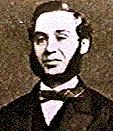
 Levi Strauss (1829-1902) was an entrepreneur who invented and marketed blue jeans. Trained as a tailor in Buttenheim, Bavaria, Germany, Strauss went to San Francisco, USA from New York in 1853. Strauss sold dry goods, including tents and linens to the 49ers (the people who came to the California gold rush, which began in 1849). In 1873, Strauss and Jacob Davis, a Nevada tailor, patented the idea (devised by Davis) of using copper rivets at the stress points of sturdy work pants. Early levis, called “waist overalls,” came in a brown canvas duck fabric and a heavy blue denim fabric. The duck fabric pants were not very successful, so were dropped early on. His business became extremely successful (and still is), revolutionizing the apparel industry.
Tea bags were invented by Thomas Sullivan around 1908. The first bags were made from silk. Sullivan was a tea and coffee merchant in New York who began packaging tea sample in tiny silk bags, but many customers brewed the tea in them (the tea-filled bag was placed directly into the boiling water where the tea brewed, instead of the traditional way of brewing loose tea in a teapot). Later tea bags were made of thin paper.
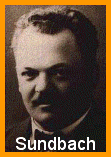
 The zipper was improved by the Swedish-American engineer, Gideon Sundbach, in 1913. Sundbach was also successful at selling his “Hookless 2.” Sundbach sold these fasteners to the US Army, who put zippers on soldiers’ clothing and gear during World War I.
The word zipper was coined by B.F. Goodrich in 1923, whose company sold rubber galoshes equipped with zippers. Goodrich is said to have named them zippers because he liked the zipping sound they made when opened and closed.

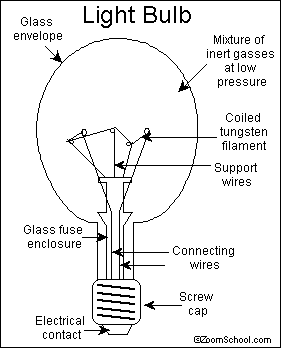 The first practical electric light bulb was made in 1878 simultaneously (and independently) by Joseph Wilson Swan and Thomas Alva Edison.
Sir Joseph Wilson Swan (1828-1914) was an English physicist who was determined to devise a practical, long-lasting electric light. After many years of experimentation, he found that a carbon paper filament worked well, but burned up quickly. In 1878, he demonstrated his new electric lamps in Newcastle, England.